
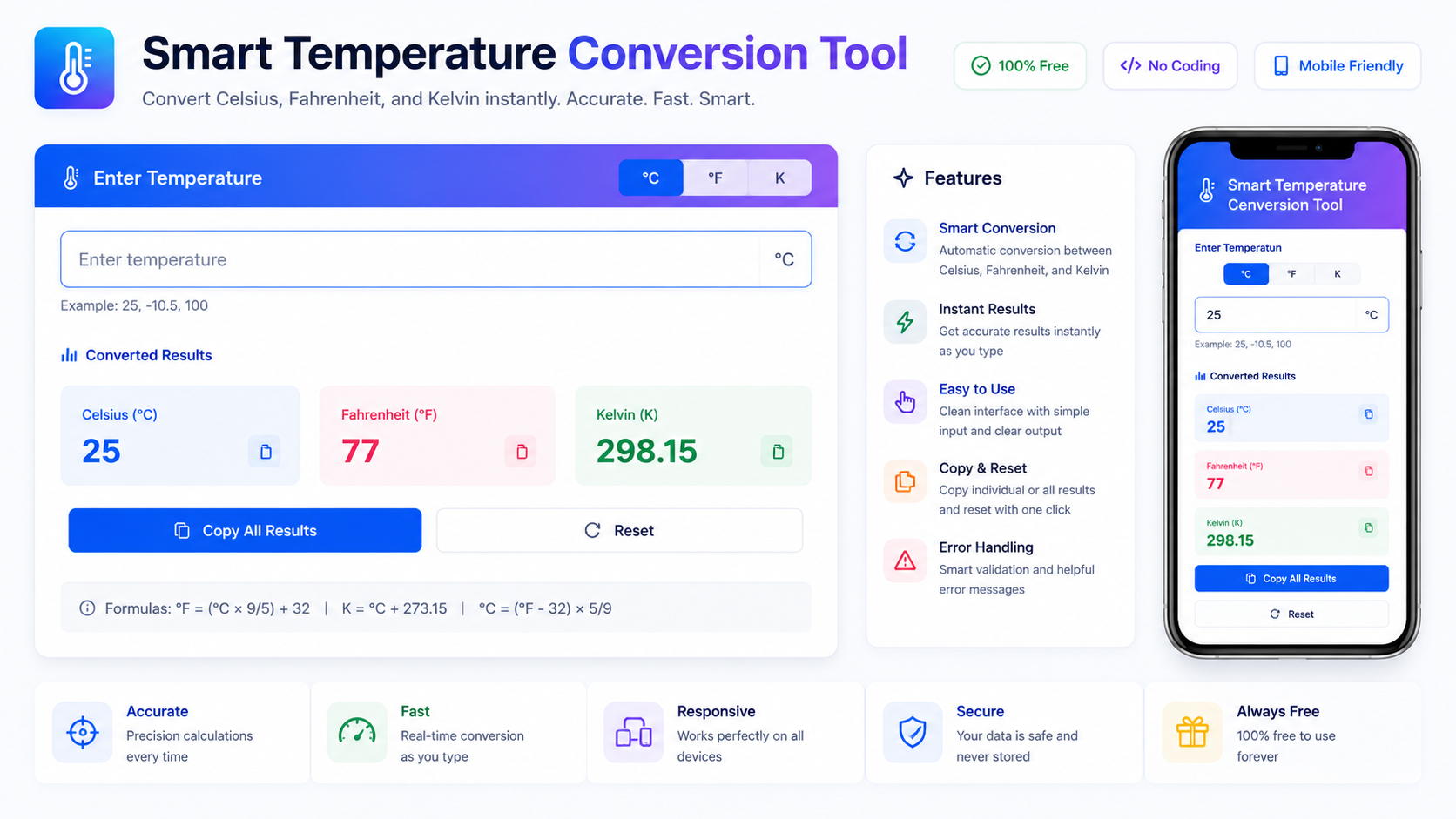
Smart Temperature Converter: A Beginner-Friendly Guide
A smart temperature converter helps users quickly switch between Celsius, Fahrenheit, and Kelvin without performing manual calculations. Whether someone is checking weather forecasts, adjusting recipe temperatures, studying scientific concepts, or planning international travel, a smart temperature converter provides instant and accurate results. Thanks to modern AI-powered website builders, creating this type of utility tool no longer requires programming experience.
Why Create a Temperature Conversion Tool?
Temperature conversion is a common task across many industries and everyday activities. An online converter makes these calculations easier, faster, and more reliable.
Some popular use cases include:
Understanding Weather Reports
Many countries use different temperature scales. A conversion tool helps users understand local forecasts regardless of the unit being used.
Adjusting Cooking Temperatures
Recipes from different regions often use Celsius or Fahrenheit. Accurate conversion helps prevent cooking mistakes.
Supporting Students and Teachers
Educational users frequently need temperature calculations for science and mathematics projects.
Assisting Travelers
International travelers often encounter unfamiliar temperature measurements and need quick conversions.
Planning Your online temperature calculator Features
Before building your online temperature calculator application, identify the functionality users expect.
Essential features include:
- Temperature input field
- Celsius, Fahrenheit, and Kelvin support
- Automatic calculations
- Clear result display
- Mobile responsiveness
- Error handling
- Copy and reset functions
Starting with these core features creates a solid foundation for future improvements.
Designing a Better no-code temperature converter
The best temperature calculators focus on speed and simplicity.
A typical user journey looks like this:
- Enter a temperature value.
- Select the original unit.
- View converted results instantly.
- Copy or save the results.
- Start another conversion if needed.
Reducing unnecessary steps improves usability and encourages repeat usage.
Build a no-code temperature Converter Using AI
Modern AI website builders can generate a fully functional no-code temperature converter within minutes. Instead of writing code manually, users can describe the desired functionality and allow AI tools to create the initial version automatically.
🚀 Ready-to-Use AI Prompt
Copy and paste the prompt below into your preferred AI website builder or no-code app creator.
Create a modern temperature conversion web application.
Requirements:
- Allow users to enter a temperature value.
- Support Celsius, Fahrenheit, and Kelvin.
- Convert values automatically as users type.
- Display results inside separate cards.
- Show simple formula explanations.
- Add reset and copy buttons.
- Prevent invalid temperatures below absolute zero.
- Include a recent conversion history section.
- Create a clean and responsive interface suitable for desktop and mobile devices.
Customizing the Interface
Once the first version is generated, focus on improving appearance and usability.
Display Results Clearly
Users should immediately see converted values without scrolling.
Use Easy-to-Read Labels
Each result should clearly identify the associated temperature scale.
Optimize for Mobile Devices
Many visitors will access the tool from smartphones and tablets.
Add Helpful Examples
Reference temperatures can improve user understanding.
Examples include:
- Freezing point of water
- Boiling point of water
- Typical room temperature
- Common oven settings
Implement Accurate Conversion Logic
Reliable formulas are the foundation of every smart temperature converter.
Common conversions include:
Celsius to Fahrenheit
Multiply the Celsius value by 9/5 and add 32.
Fahrenheit to Celsius
Subtract 32 from the Fahrenheit value and multiply by 5/9.
Celsius to Kelvin
Add 273.15 to the Celsius value.
Kelvin to Celsius
Subtract 273.15 from the Kelvin value.
Validation rules should also prevent impossible temperatures below absolute zero.
Testing Your Temperature Calculator
Before publishing, test the application using known values.
Recommended examples:
| Input | Expected Result |
|---|---|
| 0°C | 32°F |
| 100°C | 212°F |
| 32°F | 0°C |
| 212°F | 100°C |
| 273.15K | 0°C |
Verify:
- Formula accuracy
- Unit switching
- Error handling
- Mobile responsiveness
- Loading speed
Publishing Your Online Converter
Once testing is complete, publish the tool and make it available to users.
Common audiences include:
- Students
- Teachers
- Travelers
- Home cooks
- Weather enthusiasts
- Science learners
A smart temperature converter can also become part of a larger collection of online calculators and utility tools.
Additional Features to Consider for online temperature calculator
After launch, consider expanding functionality based on user feedback.
Conversion History
Allow users to revisit previous calculations.
Saved Favorites
Store commonly used temperature values.
Additional Measurement Scales
Expand support to include Rankine and other units.
One-Click Sharing
Allow users to share results quickly.
Dark Mode Support
Provide a more comfortable viewing experience for some users.
Common Mistakes to Avoid
When creating a temperature conversion tool, avoid these common issues:
- Incorrect conversion formulas
- Missing validation rules
- Confusing result layouts
- Poor mobile usability
- Slow performance
Regular testing and updates help maintain accuracy and user satisfaction.
A temperature conversion tool is a practical online utility that serves students, travelers, educators, cooks, and everyday users. With modern AI-powered tools, building a smart temperature converter no longer requires coding knowledge. By focusing on accuracy, simplicity, and responsive design, you can create a useful resource that attracts visitors and provides long-term value.
Follow Us on Facebook